Horizons Customer Magazine 2026
Optimization Meets Production: Q&A with Luca Waber
"Ensuring the same level of toolmaking excellence is part of our culture company-wide."
Feintool’s 18 manufacturing plants around the globe offer different capabilities and serve their different regional markets in distinctive ways, yet one vital craft is important to all of them and foundational to all the work they do. Excellence in toolmaking is essential to Feintool’s success and our service to customers. We continually work to cultivate skilled and talented toolmakers. An apprenticeship program for developing new toolmakers has been part of Feintool’s training system for nearly 40 years. And along with this commitment to developing individual talent comes a commitment to ensuring that the same level of toolmaking excellence is part of our culture company-wide, a value we realize by sharing toolmaking knowledge and craft between our different plants.
Feintool’s Luca Waber is currently fulfilling an assignment that exemplifies this. The eight-year toolmaking team member (including four years of apprenticeship) previously worked with the Tool Optimization group at our plant in Lyss, Switzerland—his home country. But at the request of CEO Lars Reich, Luca undertook a one-year assignment in the Czech Republic, serving as Tool Optimization Lead at Feintool’s plant in the Czech city of Most.
The aim was that Luca would offer valuable knowledge to the Most team, and he has. But he says he finds that he has learned just as much from the assignment.
Horizons recently connected with Luca in the midst of his Czech assignment to ask him about his work and his experience so far.

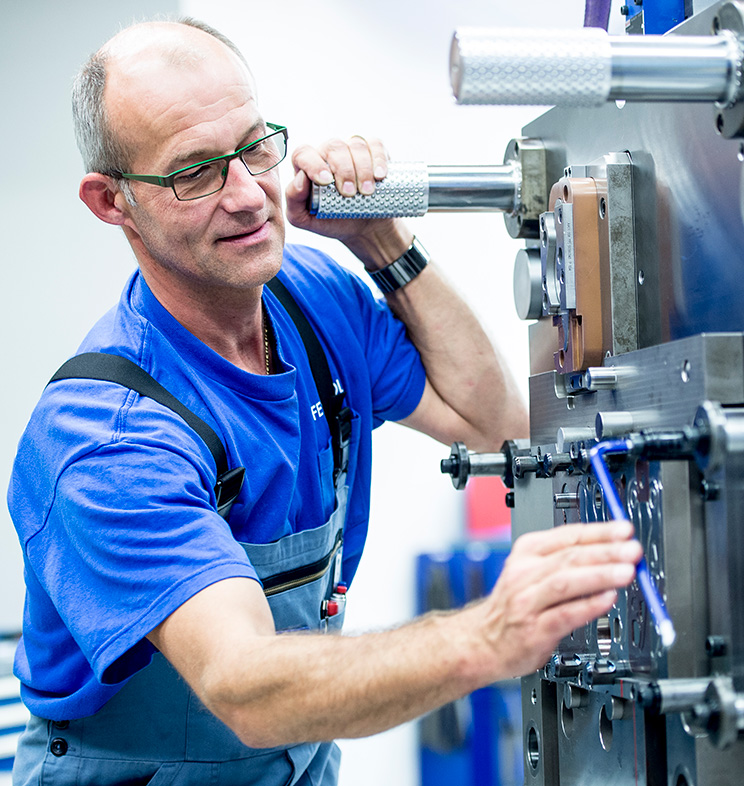
Luca Waber is on a one-year assignment from Lyss, Switzerland, currently serving as Tool Optimization Lead in Most, Czech Republic.
Horizons: Luca, could you start by telling us about your work history and how you were trained?
Luca Waber: About eight years ago, I began my apprenticeship at Feintool in Lyss, Switzerland. The program was four years long. For the first two years, we focused on basic skills—milling, drilling, turning—what we call “polymechanic” training in Switzerland. It’s essentially working with metal to make parts.
In the final two years, I chose to specialize in tool assembly. That meant assembling fineblanking tools, which I found fascinating. They range from simple to very complex, and I had the chance to work with almost every type. I stayed in tool assembly for about six months after my apprenticeship, then moved to the Tool Optimization department, where I worked for about three years.
Horizons: What did your role in the Optimization department involve?
Luca: I learned to work with tools on the press. I was trained on large fineblanking presses and learned to optimize tools for performance. After about a year, I began traveling to customer sites to set up tools—places like ZF in Germany, other companies in Switzerland, and various Feintool plants in Europe. That gave me exposure to many different operations.
Horizons: How did the opportunity in the Czech Republic come about?
Luca: At the end of 2024, I came to the Most plant to help set up a tool and troubleshoot another that had problems. We brought that tool back to Switzerland, optimized it, and returned it. I visited Most again soon after. During one of those visits, CEO Lars Reich asked if I would consider a longer assignment to help the team here, transferring from Switzerland. I said yes, of course. I started in April 2025 and have a one-year contract through next April.
Horizons: Tell us about the Most plant—what capabilities does it have?
Luca: We have three fineblanking presses: a smaller XFT servo-mechanical press for small parts, an HFA 4500 hydraulic press, and a larger HFA 8800 for larger parts. Some tools have been transferred from Lyss to Most, and production on the big press with those tools is starting soon. We also have one double-disc grinding line and will be adding another from Lyss. There are also automated turning and drilling machines, plus tumbling, brushing, and grinding equipment.


"I am learning every day," Luca says. While he brings understanding of root-cause analysis of tooling, the Most team understands serial production over long runs. "They have their approach, I have mine, and it works in the end," he says. "Sometimes I face something I don’t immediately know how to solve, and together with the team we find a way."
Horizons: What value are you bringing to the team in Most?
Luca: My background in tool optimization gives me a different perspective. I focus on finding and fixing the root cause of a problem rather than just addressing the symptoms. In Switzerland, I learned from colleagues with 30 or 35 years of experience in optimization. That training taught me to think in a special way about tools and processes.
Here in Most, I combine that mindset with the local team’s deep knowledge of serial production. In optimization, I might have run at most 10,000 strokes or 10,000 parts with a tool, and often much fewer than that—maybe 10 or 20 strokes in some cases. But here in Most we need to run 60,000 strokes in a row or even more with a tool without issues. The thinking is different, so together we adapt and find the best solutions.
Horizons: Can you give an example of your current work?
Luca: This week I’ve been building a knowledge database for tool maintenance, both digital and on paper, so the team has complete, useful information about each tool. We also had a tool causing big problems. We tried solutions from both my perspective and the team’s, and in the end agreed to do a complete overhaul, including external grinding.
My role is often to be present where problems appear, work with the team to analyze the cause, and decide how to prevent it from happening again. It’s about sharing what I know, learning from them, and always working together toward the solution.
Horizons: Outside of work, how do you find life in the Czech Republic compared to Switzerland?
Luca: What really stands out is the people. They are open, friendly, and form deep connections, even in the workplace. Once they accept you, it’s like being part of a family.
Horizons: What has this assignment meant for you personally?
Luca: I really like the job here. I’m learning every day. Sometimes I face something I don’t immediately know how to solve, and together with the team we find a way. They have their approach, I have mine, and it works in the end. Every day I see something new, and that makes this experience very valuable.