Horizons Customer Magazine 2026
Resilience: The Vital Attribute for Success in Automotive Today

Lars Reich
CEO
Because the market is more uncertain and volatile than ever before, how we respond to change matters more than ever.
Delivering value to customers and finding opportunity in automotive production do not have to decline as business conditions become more challenging. At Feintool, we are increasing production in key markets by earning more business from automotive customers. The recent expansion of our plant in Nashville, Tennessee, is a direct expression of this. In the current automotive market, the only way to grow business is by increasing market share. And the only way to increase market share, given the current market conditions, is through an operating strategy that emphasizes resilience.
Resilience is our focus now, and it will be the crucial ingredient in Feintool’s success moving forward.
The word means something more than just determination or toughness. “Resilience” is the capacity to withstand or recover quickly from a sudden or disruptive change. The concept is bigger than manufacturing—the natural world is founded on resilience (see sidebar). And as we confront the dramatic reshaping of the automotive marketplace and the corresponding increase in uncertainty, we see clearly that resilience is the proper response.
Powertrain Choice and Unpredictability
This uncertainty in automotive is the result of technological advance. Until recently, serving the automotive industry almost universally meant meeting the demand for internal combustion engines. Today, battery-powered and hybrid electric vehicles are also established, and every major automaker has offerings of all three vehicle types.
The problem: The adoption of the newer vehicle types is still at such an early stage that automakers do not know how many of these vehicles will be sold. They do not know what mix to forecast. The uncertainty is complicated by the volatile, even fickle nature of government incentives for electric vehicles. Multiple national governments have abandoned or reduced their support for EV purchases, and have done so with little notice or transition. Thus, at best, car makers can forecast how many vehicles they will sell overall, but they have no confidence in their ability to predict the proportion of demand for the different powertrains within this total. And because these newer vehicles will continue to evolve and acceptance of them will evolve as well, and because still other options may arrive (hydrogen-powered vehicles, for example), we do not expect this environment to stabilize
As a supplier of automotive components, notably powertrain parts, this uncertainty reaches us through business arrangements we never would have expected even three years ago. Today, we might learn we have won the contract to produce a particular part or part family for an automaker, but we might not be given reliable or actionable information about how many parts to expect to make. We can still succeed given this ambiguity, but the path forward is different from the way we previously would have advanced.
Resilience vs. Vulnerability: What it Means to Us
The ability to make quick pivots without major gaps in delivery is the essence of industrial resilience, and it requires a company-wide commitment.
The opposite of resilience is vulnerability, which is the state of being too inflexible within current market conditions, or too dependent on the current customer mix.
Some of the distinctions between a resilient organization and a vulnerable organization are as follows. In every one of these areas, Feintool aims for resilience:

Quick Pivots on Capital Investment
For example, the ambiguity makes capital equipment decisions difficult. In the past, if a program with a customer seemed to suggest the need for three more presses in the future, then we would invest in the presses to begin building that capacity. Even if something would happen to the program, we could be confident of filling the capacity with some other comparable program we might win.
Today, by contrast, if a program suggests a potential need for three presses, there is so much uncertainty around the quantity creating this need, and so much diversity of the different types of parts we might be asked to produce, the only reasonable strategy is cautious resilience. We add equipment incrementally, albeit quickly, moving just when we must, watching for the moment to act fast with either an additional capacity investment or a pivot away from a capital investment we otherwise might have made.
This nimbleness is a new requirement of the market, but it translates directly into benefits for our customers. They face dynamic business conditions as well. Our ability to adapt quickly, and even to adapt in different ways within the different regions we serve, translates to greater long-term stability and support for our customers even as we maintain on-time delivery in the face of shifting part demands.
Resilience Demands Global Skilled Workforce
Regional autonomy is one characteristic of a resilient global company. Feintool believes in regions: The company has 18 plants within three major regions of the globe, with very little exporting between regions.
However, the autonomy does not mean separation when it comes to culture, best practices or skills. A resilient global organization demands a resilient workforce trained to the same level of excellence around the globe.
Feintool has always seen the importance of overseeing its own training. The company has maintained a strong apprenticeship program consistently for nearly 40 years. And in an organizational system in which regional plants serve their own regions, this means training investment like this has to be in every region we serve.
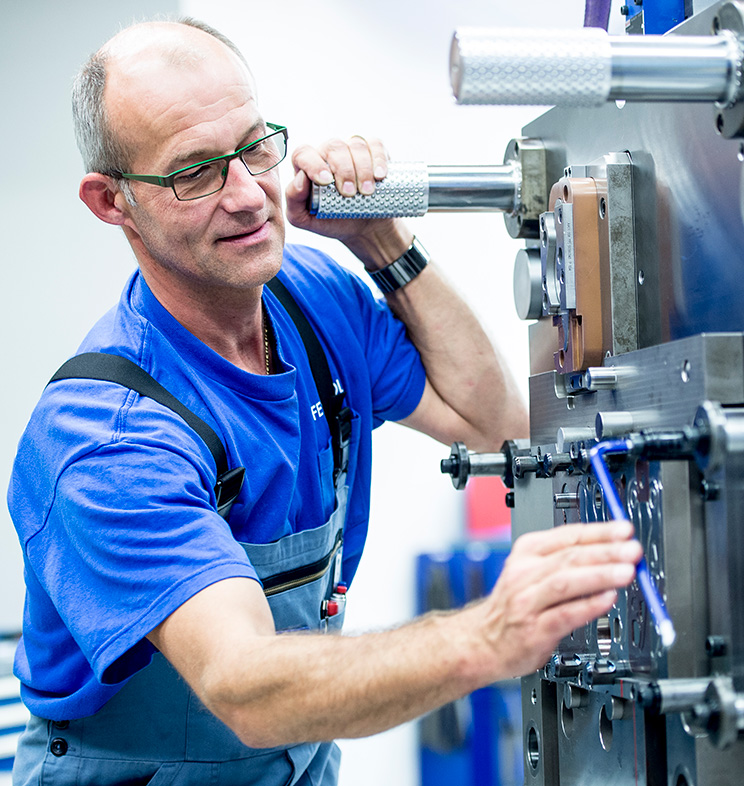
The photo shows an example of the international skills sharing in action. Luca Waber, who apprenticed with Feintool in Switzerland, is currently serving a one-year assignment as a tool maintenance lead at Feintool’s plant in the Czech Republic.

Luca Waber, who apprenticed with Feintool in Switzerland, is currently serving a one-year assignment as a Tool Optimization Lead at Feintool’s plant in the Czech Republic.
Automotive and Beyond
The focus on resilience has value far beyond the automotive sector. Resilience is our response to technology change in the automotive industry, and to the way the expanded range of choice for automotive consumers expands the complexity and uncertainty of automotive manufacturing.
However, other durable-goods markets will see, or are already seeing, this same kind of technology-driven expansion of products. We anticipate this type of change in automation hardware, robotics, appliances, data centers—all of which are markets we also serve. The resilient approach is not just the way to succeed in automotive production. Resilience ought to be the new operating mode of manufacturers everywhere.

A decade ago, who could have known how much choice and variability was coming to the automotive market? Automotive production once meant production of internal combustion vehicles. Today, hybrid and electric vehicles are also well-established, but customer preference is not well understood. As a result, predictions about powertrain production are highly uncertain.

Demand uncertainty does not mean capacity investment halts. Rather, the uncertainty means capacity investment choices have to be made responsively and decisively. Seen here: New forming press recently added to our plant in Nashville.
Resilience in Nature
Nature is full of examples of resilience — the ability to survive, adapt and recover from sudden or extreme disruption.
The tardigrade, or water bear, is a microscopic animal that can survive in boiling water, subzero temperatures, radiation and even the vacuum of space. When conditions become hostile, it enters a state called cryptobiosis, suspending its metabolism until the environment becomes livable again.
Redwood trees, some over 2,000 years old, survive frequent wildfires thanks to thick, fire-resistant bark and regenerative growth. Even when a tree is heavily damaged, it can resprout from its base or roots, regenerating over time.
The axolotl, a type of salamander, has regenerative capability so advanced it can regrow limbs, parts of its heart, spine, and even brain tissue.
The Arctic ground squirrel can supercool its body below freezing without cell damage during hibernation, reanimating in spring. This metabolic control helps it endure months of frozen isolation.
Coral reefs, though sensitive, have also shown surprising resilience. In an adaptive response to climate change, some species have shifted their symbiotic algae to ones better suited to warmer temperatures.
These examples do not demonstrate resistance to change, but rather they demonstrate nature’s high level of investment in accepting and responding to change. In nature, as in business, survival does not necessarily go to the most powerful. It goes to those best able to adapt.